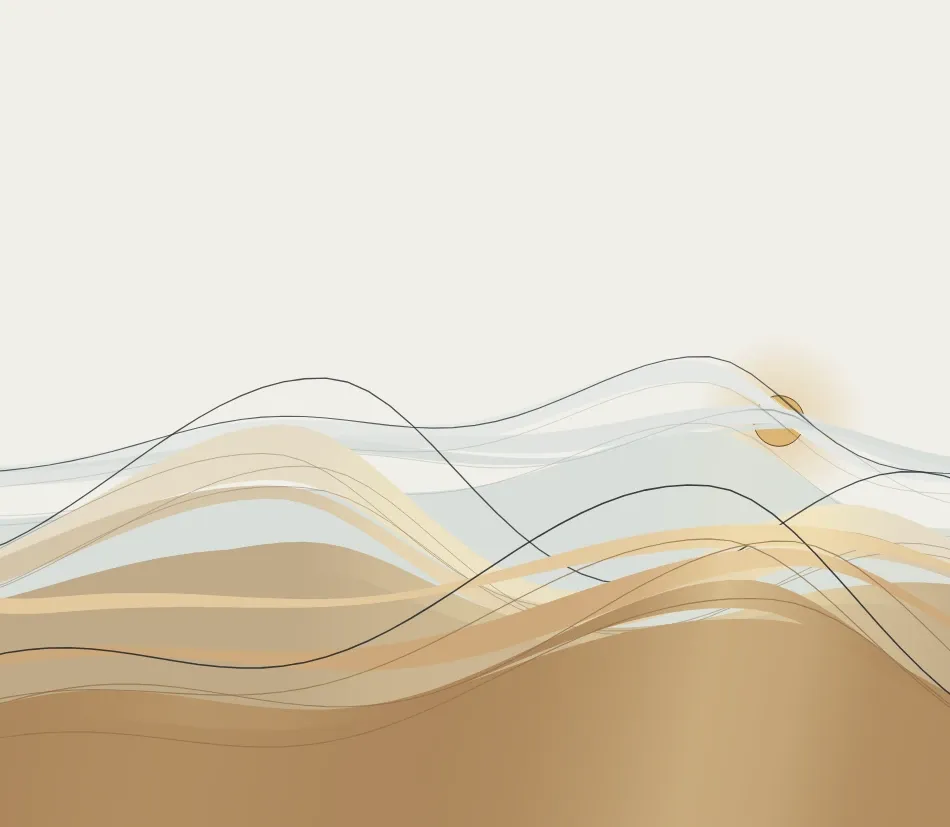
Dunes at dusk
Follow a crest past the low light. The foreground slips ahead while the horizon barely moves.
Watch the gap between a fine line and the ribbon of sand beneath it. If they travel together, they belong to the same ridge. A line that overtakes the ribbon belongs to a nearer dune.
Pause the wind and drag Time shift to slide a crest across the sun or moon. Move the light from right to left to see the opposite face catch it. Choose Deep to pick out the bright crest against the darker slope.
Why this plate
I wanted the archive’s opening landscape to hold up on its own. A low sun gives the eye a fixed point. Keep looking there and the space between two ridges becomes visible through their difference in speed.
To see a World in a Grain of Sand
How it’s made
Drawing a ridge
We kept a little of the distortion from the opening waves on the homepage. Each of the three ridges has four ink contours, three ribbons of sand and a base that fills the ground below. We offset their edges slightly so that slivers of sky can show through. The contours and sand of each ridge travel together.
Making distance visible
We draw each ridge beyond the edges of the frame and join the ends of its profile. When a peak leaves on the right, the next one is already arriving on the left. At the default wind speed, the far ridge completes a circuit in seven minutes. The middle ridge does it in two minutes and twenty seconds, and the nearest in one minute. Wind speed scales all three clocks together. Time shift adds up to sixty seconds to all three, so you can scrub through a full circuit of the nearest dune.
Lighting the sand
We compare the slope of the sand with the direction to the low sun or moon. A face turned toward it picks up a lighter shade from the palette. Moving the light along the horizon changes which slopes face it. The Original setting uses the homepage colors. Deep brings the shaded faces closer to the darkest tone in the palette and lifts the lit crests. Shallow mixes more of the crest color into the shaded faces. When a ridge crosses the sun or moon, look for the change in contrast close to its edge. Direct light scatters in the eye and softens that detail. Cover part of the source and the detail comes back. We sample five columns of 32 points across the actual sun or crescent. The fraction still visible sets the strength of the glare, and its centre follows the light that gets through.
This plate uses the homepage’s idle animation. We prepare the vector paths, gradients and glare timings up front. During drift, the browser moves the layers and blends their prepared light levels.
Published 26 November 2026. Generative landscape.